Specifications need context, not just a bigger number
With LED light devices, it is tempting to compare the biggest number on a product page. A better sequence is to ask what each number measures, at what distance, across what area and for what exposure time. Only then do specifications become comparable.
Red and near-infrared light are often discussed as red light therapy or photobiomodulation. Evidence is not equal across uses or home devices, and published studies use different devices, timings and outcomes. Results therefore cannot be transferred directly from one specification or study to another product. [1] [2]
Wavelength: what nm actually tells you
A nanometre, or nm, describes the wavelength of light. It identifies the light; it is not a strength score. Red light is visible, while near-infrared light is invisible to the eye, and both may appear on one specification. Wavelength affects how light scatters and is absorbed in tissue, which also affects how deeply it can penetrate. [2] [3]
Look for specific nm values rather than a colour name or a claim of “more spectra”. Do not assume one wavelength is automatically better than another. In the scientific literature, appropriate parameters depend on the objective and other conditions; the nm label alone does not settle the question. [3]
mW/cm² and distance: where was that number measured?
Irradiance, stated in mW/cm², describes how much optical power reaches a given area at a given moment. It is more informative than device watts alone because the same total power spread over a small or large area produces very different power density. [3]
Always look for the distance and the method: was the value measured at the device surface or, for example, 10 cm away; is it the beam centre, an average across the field or a peak; and what was the measurement area? Position, angle and separation can change the light delivered to skin. Without those details, comparing “100 mW/cm²” with another device is not meaningful. [3]
Dose in J/cm²: a formula, not a universal recipe
Dose, also called fluence, expresses energy per area in J/cm². When irradiance is known at the actual use distance, a simple calculation is: J/cm² = mW/cm² × seconds ÷ 1,000. As a label-reading example, 20 mW/cm² for 300 seconds equals 6 J/cm² at the measurement plane. [3]
The same calculated dose does not guarantee the same effect when wavelength, intensity, geometry, area or objective changes. A review of the literature notes that no single fluence always produces a positive photobiomodulation effect, and that the relationship between intensity and time does not hold equally across all ranges. Use J/cm² for transparent comparison, not as a stand-alone treatment instruction. [3]
Power draw, rated power, LED count and coverage
Power draw describes the electrical energy a device takes from its mains supply or charger. Rated power may refer to an electrical operating specification, while optical light delivery is another measure. Watts by themselves do not replace irradiance at the skin and a stated measurement area. [3]
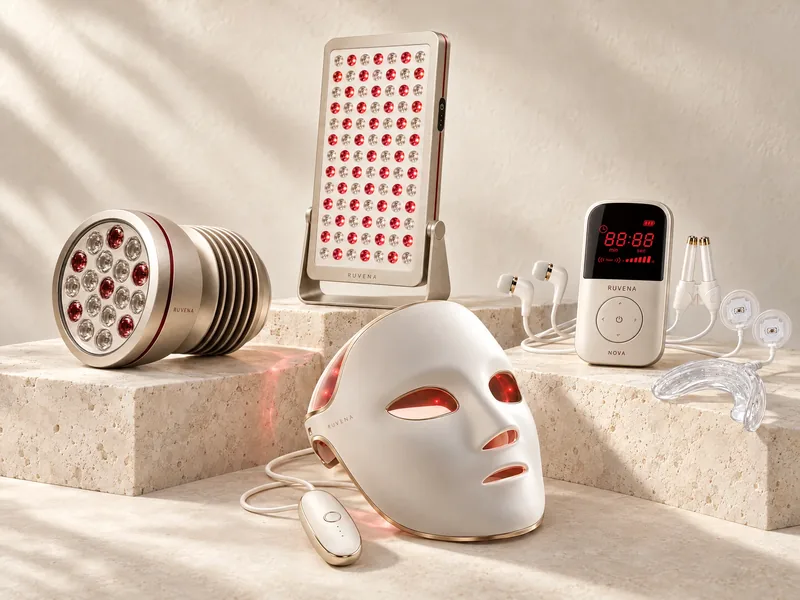
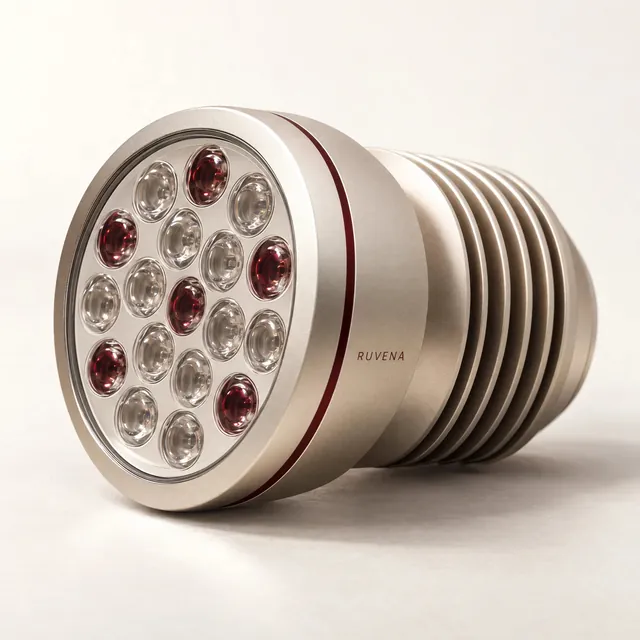
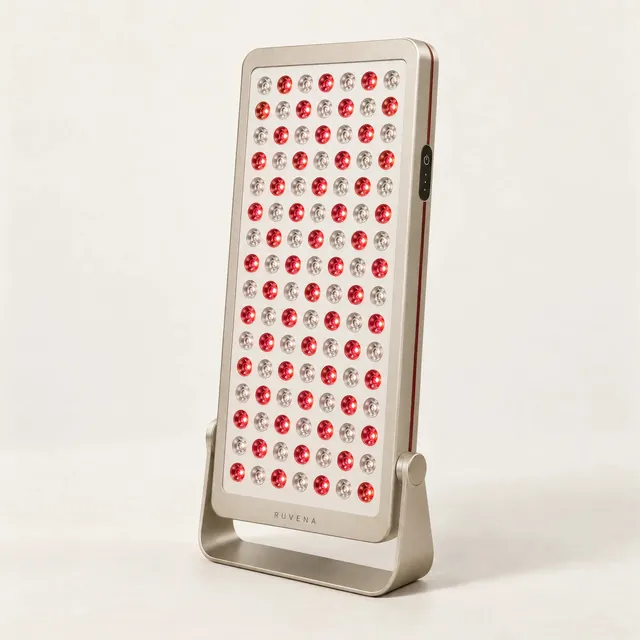
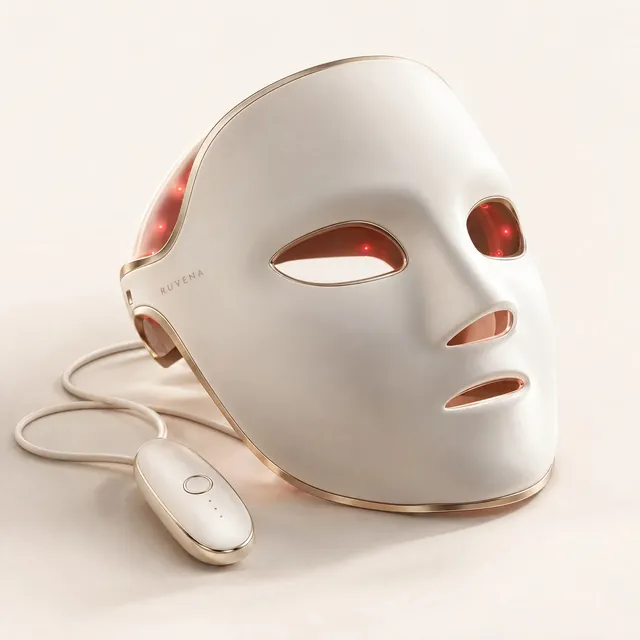
LED count describes part of a product’s construction; it does not by itself prove larger coverage or better uniformity. Ask for the active illuminated area at the stated distance and whether light distribution is described. For a smaller targeted routine, the Focus compact lamp is a practical format; for a broader area, the Balance panel is practical; and the Aura mask follows facial contours. These are format and routine differences, not promises of results.
If you have a skin condition, light sensitivity or take medicines that increase photosensitivity, speak with a healthcare professional before use. Follow the directions for the specific device and use eye protection when instructed; the long-term safety of home devices is not fully understood. [1] [2]
Sources
Find your light ritual.
Face care, a targeted area or a little more space? A few simple questions help you find the device that fits your everyday life.
- Five short questions
- Clear reasons for your match
- All four RUVENA devices